TITLE OF THE MANUSCRIPT
First B. Author 1, Second C. Coauthor 2 and Last Author 1,3
1Department, University, City, Country
2Department, University, City, Country
3Department, University, City, Country
ABSTRACT:
These guidelines are provided for the preparation of papers submitted for publication in the 5th International Conference on Advanced Science and Engineering (ICOASE) 2025. These guidelines are issued to ensure a uniform style. Reproduction is made directly from author-prepared manuscripts electronically in A4 paper size 21 cm x 29.7 cm. To ensure timely and efficient production, authors must submit their manuscripts in strict conformance with these guidelines. The Editorial Board may omit any paper that does not conform to the specified requirements. There will be no opportunity for corrections or improvements of poorly prepared originals.
Keywords: Manuscripts; University of Zakho; Duhok Polytechnic University; Template
1. Introduction
The introduction section of your paper should include the necessary background information, including an adequate review of earlier findings and the justification for conducting this study.
2. Materials and Methods
In the materials and methods section, please describe all necessary details on how the study was performed. Do not include any discussions of the work in this section. Enough information should be given so that other researchers can reproduce your study.
3. Results
Use this section to present the results from the measurements or studies that were described in the last section, but without going into any discussion about the results.
All figures and Tables should be numbered consecutively. Figures must be placed in the appropriate location in the document, as close as practicable to the reference of the figure in the text. Figures may be in color or black and white and must be of such quality that they produce clear and sharp printouts on an ordinary (color) laser printer.
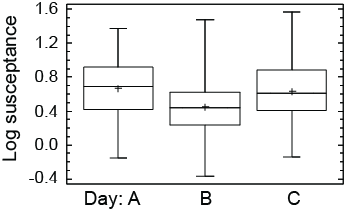
Fig.1: Box-plot showing median value (line), mean value (cross), middle 50% (box) and smallest and largest point within 1.5 interquartiles from the box (whiskers) of all measurements on days A, B and C.
4. Discussion
Now you can discuss your results. Emphasize the new and important aspects of the study and the conclusions that follow from them. Do not repeat in detail data or other information given in the Introduction or the Results section. After this section, there may be sections called Conclusion and Acknowledgments. The last section is References.
5. Conclusions
A conclusion section is required. Although a conclusion may review the main points of the article, do not replicate the abstract as the conclusion. A conclusion might elaborate on the importance of the work or suggest applications and extensions.
Reference
References should be indicated in the typescript by giving the author’s name, with the year of publication in parentheses, as detailed in the APA style guide. For example thus (Mustafa, 2013), and listed in alphabetical order in the reference section in standard APA format. The following arrangements should be used:
Ardila, J., Bijker, W., Tolpekin, V., & Stein, A. (2012). Gaussian localized active contours for multitemporal analysis of urban tree crowns. Paper presented at the 2012 IEEE International Geoscience and Remote Sensing Symposium. DOI: 10.1109/IGARSS.2011.6049856
Ceder, A. (2014). Public Transit Planning and Operation: Theory, Modeling and Practice, Second Edition: Taylor & Francis Group.
Digital Globe. (2009). The benefits of the 8 spectral bands of WorldView-2. Retrieved January 13, 2014, from http://www.satimagingcorp.com/media/pdf/WorldView-2_8-Band_Applications_Whitepaper.pdf
Mustafa, Y. T. (2013). Satellite Remote Sensing for Spatio-Temporal Estimation of Leaf Area Index in Heterogeneous Forests. International Journal of Environmental Protection, 3(4), 10-16.
Mustafa, Y. T., Tolpekin, V. A., & Stein, A. (2014). Improvement of Spatio-temporal Growth Estimates in Heterogeneous Forests Using Gaussian Bayesian Networks. IEEE Transactions on Geoscience and Remote Sensing, , 52(8), 4980-4991. DOI: org/10.3390/rs12182934
Smith, J. (2000). Remote sensing to predict volcano outbursts. The International Archives of the Photogrammetry, Remote Sensing and Spatial Information Sciences, 456-469.DOI: 10.1016/j.jvolgeores.2016.04.027
Please note the following instructions
The maximum paper length is restricted to 12 pages.
Title
The title should appear centered in bold capital letters, at the top of the first page of the paper with a size of twelve (12) points and single-spacing. After one blank line, type the author(s) name(s), affiliation and mailing address (including e-mail) in upper- and lower-case letters, centred under the title. In the case of multi-authorship, group them by firm or organization as shown in the title of these Guidelines.
Abstract
Flush left in bold Capitals. Start with a concise Abstract (150 – 250 words) which presents briefly the content and very importantly, the news and results of the paper in words such to be understandable also to non-specialists.
Keywords
Leave one line blank, then type “KEYWORDS:” in bold capital letters, followed by minimum of 5 keywords. Those key words are used to find a paper with content you are preparing.
Page Layout, Spacing, and Margins
The title and Abstract of the paper must be compiled in one column and all subsequent text (rest of the paper) must compiled in two columns. All text should be single-spaced. Left and right justified typing is needed.
Length and Font
All manuscripts are limited to a size of no more than twelve (12) single-spaced pages (A4 size), including abstracts, figures, tables and references. The font type Times New Roman with a size of nine (9) points is to be used.
Illustrations and Tables
1.1.1 Location: Figures must be placed in the appropriate location in the document, as close as practicable to the reference of the figure in the text. While figures and tables are usually aligned horizontally on the page, large figures and tables sometimes need to be turned on their sides. If you must turn a figure or table sideways. Note that the top is always on the left-hand side of the page.
Captions: All captions should be typed in upper and lower case letters, centered. For tables the captions has to be directly above the table. While, the caption of the Figure must be directly beneath the figure. Use single spacing if they use more than one line. All captions are to be numbered consecutively, e.g. Figure 1, Table 2, Figure 3.
Copyright: If your article contains any copyrighted illustrations or imagery, please include a statement of copyright such as: © company name or the book title Copyright 20xx (fill in year). It is the author’s responsibility to obtain any necessary copyright permission. After publication, your article is distributed under the Creative Commons Attribution 4.0 License and you retain the copyright.
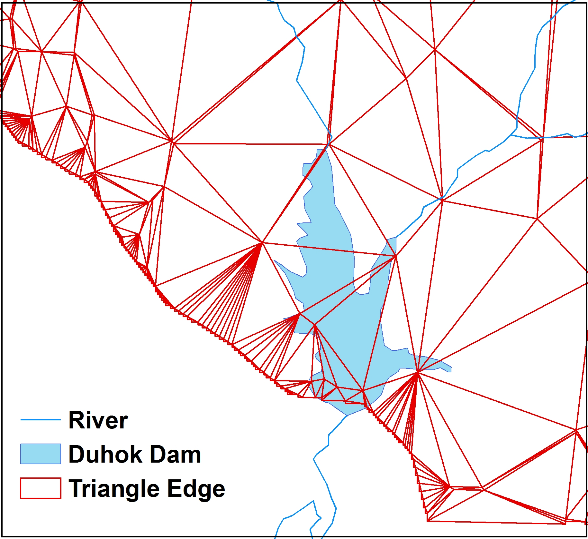
Figure 1. Figure placement and numbering
Equations, Symbols and Units
Equations: Equations should be numbered consecutively throughout the paper. The equation number is enclosed in parentheses and placed flush right. Leave one blank lines before and after equations:
where c = constant
x, y = target coordinates
X0, Y0, Z0 = initial coordinates
X, Y, Z = object coordinates
Symbols and Units: Use the Système International Units and Symbols (SI). Unusual characters or symbols should be explained in a list of nomenclature.
References
References should be indicated in the typescript by giving the author’s name, with the year of publication in parentheses, as detailed in the APA style guide. For example thus (Mustafa, 2013), and listed in alphabetical order in the reference section in standard APA format. The following arrangements should be used:
References from Journals: Journals should be cited like (Mustafa, 2014). Names of journals can be abbreviated according to the “International List of Periodical Title Word Abbreviations”. In case of doubt, write names in full.
References from Books: Books should be cited like (Ceder, 2014).
References from Conference: conferences should be cited like (Ardila, Bijker, Tolpekin, & Stein, 2012).
References from Other Literature: Other literature should be cited like (Smith, 2000).
References from websites: References from the internet should be cited like (Digital Globe, 2009).
Note: DOI for each reference should be added at the end.
Acknowledgements (optional)
Acknowledgements of support for the project/paper/author are welcome.
Appendix (optional)
Any additional supporting data may be appended, provided the paper does not exceed the limits given above.